
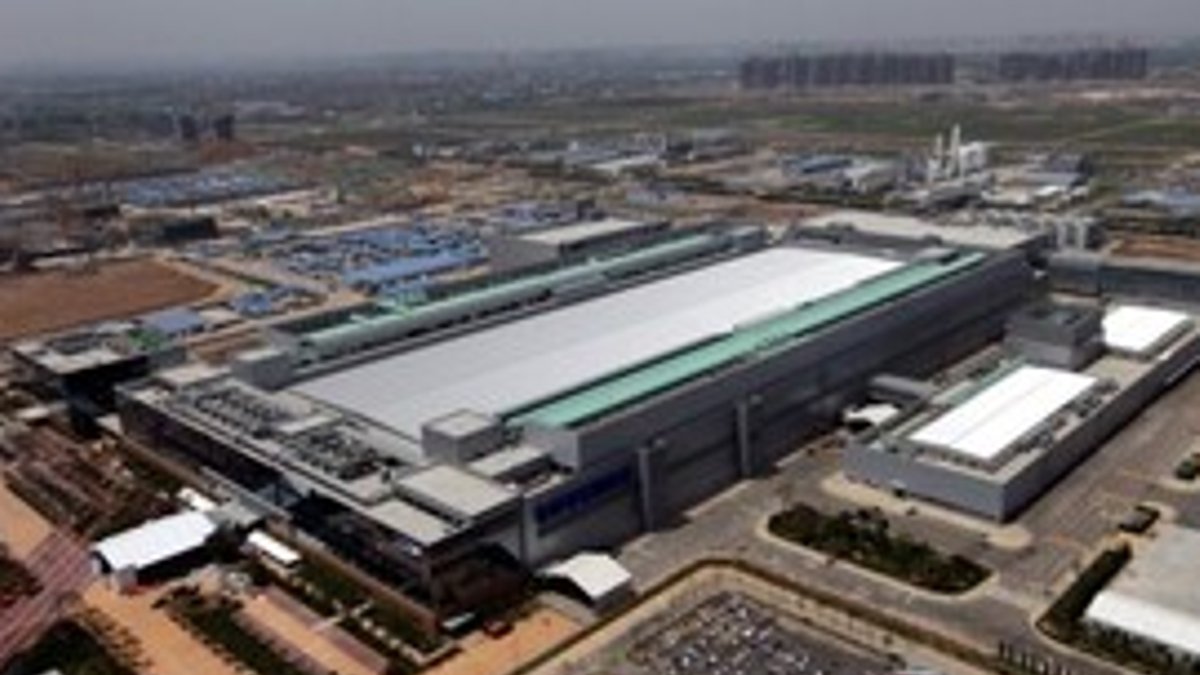
Samsung Electronics plans to boost NAND flash output at its Xi’an facility fivefold over the next year, driven by surging demand for solid-state drives in artificial intelligence data centers. The company intends to convert existing 6th-generation production lines to newer 9th-generation processes and upgrade electroplating equipment at Plant 2, raising monthly output from about 10,000 wafers to 50,000 wafers. This expansion will raise total NAND capacity in China to roughly 100,000 wafers per month, representing one-third of Samsung’s global NAND production.
Performance and Market Share
Samsung’s flagship V9 NAND uses a 286-layer architecture, providing 50% more storage capacity and 33% faster I/O speeds than the previous V8 model. The layer count is approximately 21% higher than the V8’s 236 layers, while the maximum I/O speed reaches 3.2 gigabits per second (Gbps). This represents an improvement of approximately 10 percentage points from the previous generation’s low-to-mid 80s, helping improve production efficiency and lower manufacturing costs per chip.
The company reports that V9 yield rates have climbed into the low 90s, a significant increase over prior generations. As of the second quarter, Samsung held a 35.1% share of the global eSSD market, leading second-place SK hynix by 14 percentage points. The firm introduced the PM1763 eSSD in July, capable of transferring large language models in approximately 1.4 seconds.
Market data from TrendForce indicates that eSSD demand is expected to grow 84% this year and another 55% next year, while demand for NAND in PCs and mobile devices is projected to decline. By contrast, demand for NAND used in PC SSDs and mobile devices is projected to decline by 12% and 1%, respectively, next year.
Read Also: Kurly data leak affects employees and customers
As a result, eSSDs are forecast to account for 57% of total NAND demand next year, up from 45% this year. Pricing trends reflect this divergence, with general-purpose NAND prices falling roughly 30% in the third quarter, while data center product prices continue to rise. Bank of America (BofA) noted that prices for 512-gigabit (Gb) general-purpose NAND fell approximately 30% quarter over quarter in the third quarter, as orders from PC and mobile device manufacturers weakened.
Industry observers note that Samsung is betting its massive Chinese production footprint will cement its lead against rivals like Yangtze Memory Technologies Co. (YMTC). While YMTC is expanding capacity, Samsung’s strategy of concentrating resources on high-yield, high-performance chips helps it maintain an edge. Its lead over second-place SK hynix, which held 21.1%, widened to 14 percentage points in the second quarter from 12 percentage points in the first. Micron ranked third with a 17.1% share.
The product can transfer a large language model (LLM) in approximately 1.4 seconds and offers more than 1.8 times the power efficiency of its predecessor. Industry sources expect YMTC’s monthly NAND production capacity to be approximately 70% higher in the fourth quarter of next year than it was two years earlier. The company is also adding V9 lines at its Pyeongtaek Plant 5 in South Korea, signaling a continued focus on high-value-added products despite broader market headwinds.


Leave a Reply