
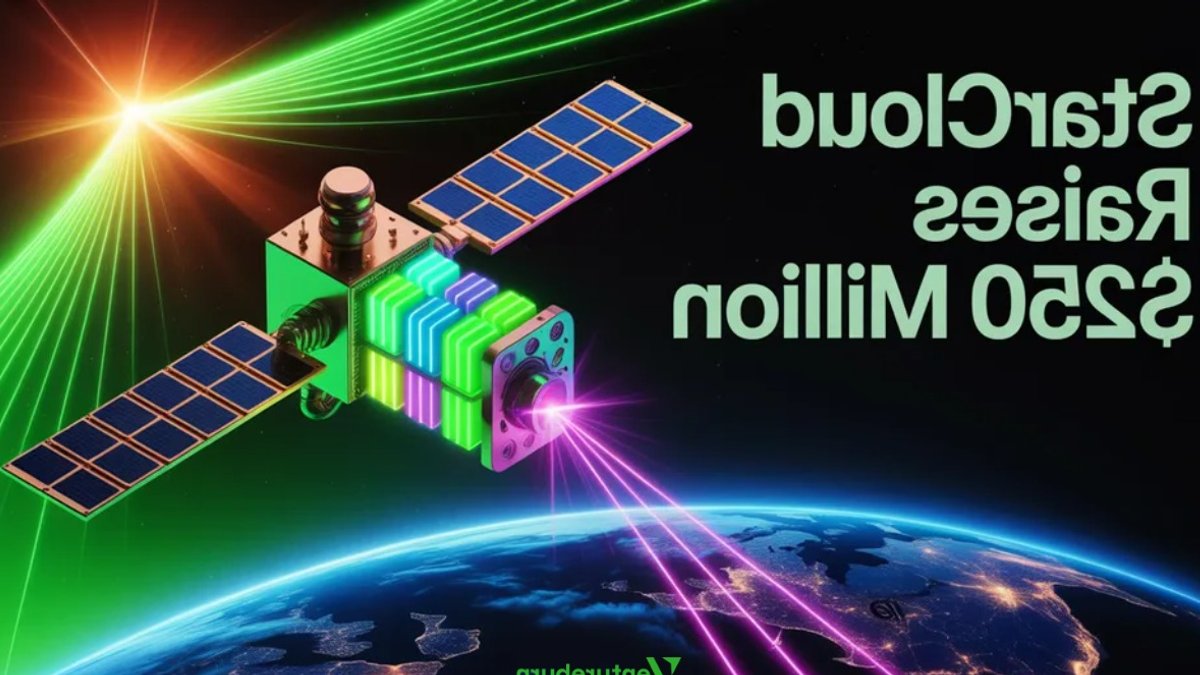
Starcloud, an AI hardware startup, has raised $250 million to construct data centers in space. The company argues that Earth-based facilities are growing too costly and energy-hungry to train the largest AI models.
The funding round was led by Manhattan West, with investments from Nvidia, Cisco Investments, and over a dozen other backers. This capital extends a Series A round the company initially announced in March.
The case for orbiting servers
Starcloud’s strategy addresses two major challenges: heat and power. AI chips produce extreme heat during training, forcing ground-based data centers to invest heavily in cooling systems. Space, however, is naturally cold.
Power consumption presents another hurdle. The largest data centers now use as much electricity as small cities, and costs continue to climb. The company plans to avoid the grid entirely by relying on solar panels that operate continuously in orbit, unaffected by clouds or nightfall.
Latency also improves with this approach. Most satellites currently collect raw data and transmit it to Earth for processing. Starcloud’s upcoming satellite, Starcloud-2, will handle processing in orbit and send only the results, cutting bandwidth requirements.
Other companies are pursuing similar ideas. SpaceX is developing its own AI satellite, AI1, featuring a 230-foot wingspan and computing power comparable to Starcloud’s planned Starcloud-3. SpaceX expects to begin mass production by late 2027.
From one card to 88,000 satellites
Starcloud’s first test launched a single Nvidia graphics card into orbit on a small satellite about 10 months ago. The experiment successfully ran an AI training job while circling Earth. The company is now scaling up operations.
Related: HSBC Private Bank appoints Feras Al Jaramani UAE
Starcloud-2 will carry AI chips, onboard storage, and a data backup module. It will support both training and inference, allowing it to learn new models and execute existing ones.
The first mass-produced version, Starcloud-3, will consume about 200 kilowatts of power and include cooling systems designed for the vacuum of space. Production lines are already being established to build these satellites at scale.
The long-term vision involves a cylindrical structure with solar panels covering 2.5 square miles. Inside, container-sized modules of liquid-cooled servers would deliver 20 gigawatts of computing power—matching the capacity of Earth’s largest data centers without land, water, or electricity constraints.
Achieving this scale would require 88,000 satellites working together. The $250 million will fund production and secure launches, with SpaceX serving as the launch partner.
The company is now concentrating on proving the concept at scale.
AI funding trends continue to push boundaries, with startups exploring unconventional solutions to computational demands.


Leave a Reply